The Best Exercises for Stronger Arms
Rows, push-ups, presses, curls, and triceps extensions build real arm strength. Here is how to do each one correctly, how often to train, and why arm exercises cannot burn arm fat.
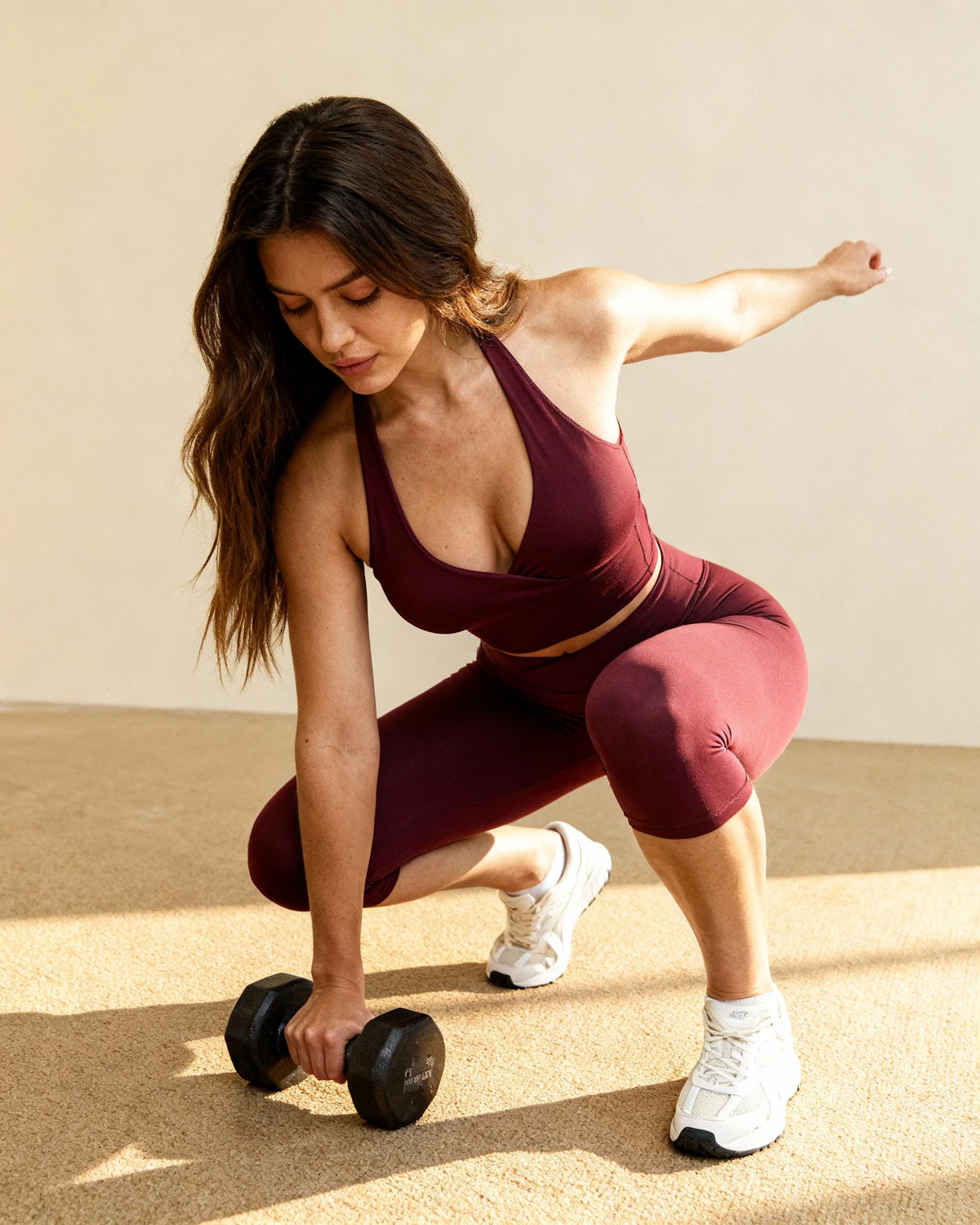
The short answer
The most effective arm exercises train pushing and pulling: rows and curls for the biceps, dips, close-hand push-ups and overhead extensions for the triceps, and overhead presses for the shoulders. Do them two to three times a week, adding weight or repetitions gradually. Arm exercises build muscle but cannot remove arm fat.
Key takeaways
- Compound pushes and pulls such as rows, chin-ups, push-ups, and presses build more arm strength per minute than isolation exercises alone.
- The triceps make up the larger share of upper arm mass, so a program built only on curls leaves most of the arm undertrained.
- The Physical Activity Guidelines for Americans call for muscle-strengthening activity covering all major muscle groups on 2 or more days a week.
- You cannot spot-reduce arm fat: arm training builds the muscle underneath, but the fat above it only comes off as total body fat falls.
- Two to three sessions a week with at least one full day between them is enough, since muscle strengthens during recovery rather than during the workout.
- Progressive overload drives strength gains more than exercise selection, and full range of motion and added repetitions come before added weight.
- Using momentum to swing a weight reduces the work done by the target muscle and increases strain on the elbow.
- See a doctor or physical therapist for sharp elbow or shoulder pain, numbness or tingling down the arm, or one-sided weakness.
Arm strength matters for far more than how your sleeves fit. Carrying groceries, lifting a toddler, pushing yourself up off the floor, and catching yourself when you trip all run through the muscles between your shoulders and your wrists.
Building real arm strength does not take a long list of exercises. It takes a few good ones, done with control, repeated for months.
What are the best exercises for stronger arms?
The most effective arm exercises are compound pushes and pulls, with a small amount of isolation work added on. Rows and chin-ups build the biceps alongside your back; push-ups, dips, and presses build the triceps and shoulders; curls and overhead extensions fill in the gaps.
The reason to lead with compound movements, exercises that move more than one joint, is efficiency. A row trains your biceps, forearms, grip, and upper back in the time a curl trains only the biceps, and heavier loads are possible, which drives more strength gain.
This fits the Physical Activity Guidelines for Americans, which ask adults to do muscle-strengthening activity involving all major muscle groups on 2 or more days a week, alongside 150 to 300 minutes of moderate aerobic activity or 75 to 150 minutes of vigorous. Arms are one part of that, not the whole of it.
Which muscles actually make up your arms?
Four groups do the work: the biceps at the front of the upper arm, the triceps at the back, the deltoids capping the shoulder, and the forearm muscles that control your wrist and grip.
The triceps make up the larger share of upper arm mass and straighten the elbow, which is why a program built entirely on curls leaves most of the arm undertrained. If your arms feel weak pushing a heavy door or getting up from the floor, the triceps and shoulders are usually the reason.
Grip strength deserves a mention of its own. It underpins every pulling exercise and every real-world carry, and it is the first thing to give out when you try to hold something heavy.
How do you do the key arm exercises correctly?
Form comes down to controlling the weight rather than throwing it. Move deliberately, use a full range of motion, and stop the set when your technique breaks down rather than when the number is reached.
Dumbbell biceps curl
- Stand tall with a dumbbell in each hand, arms straight, palms facing forward.
- Pin your elbows lightly against your sides and keep them there.
- Bend your elbows to lift the weights, without letting your shoulders shrug or your back arch.
- Pause briefly at the top, then lower over about three seconds to a fully straight arm.
- Stop the set when you start swinging your torso to move the weight.
One-arm dumbbell row
- Place one hand and the same-side knee on a bench, the other foot on the floor.
- Let the dumbbell hang straight down and set your back flat, not rounded.
- Pull the dumbbell toward your lower ribs, leading with the elbow.
- Squeeze your shoulder blade toward your spine at the top.
- Lower under control to a full stretch, and avoid twisting your torso to help.
Push-up (and the close-hand version)
- Set your hands under your shoulders, or slightly narrower to shift work to the triceps.
- Brace your core so your body forms a straight line from head to heels.
- Lower until your chest is a few inches from the floor, keeping elbows angled back rather than flared wide.
- Press up without letting your hips sag or pike.
- If a floor push-up is too hard, put your hands on a counter or bench, that is a scaling, not a failure.
Overhead triceps extension
- Hold one dumbbell with both hands and press it overhead, arms straight.
- Keep your ribs down and your lower back neutral rather than arched.
- Bend only at the elbows to lower the weight behind your head.
- Keep your elbows pointing forward, not flaring out to the sides.
- Straighten your arms to return, stopping just short of locking hard.
Overhead press
- Start with dumbbells at shoulder height, palms facing forward.
- Squeeze your glutes and brace your core to stop your back arching.
- Press straight up until your arms are extended, with your head moving slightly forward through the bar path.
- Lower under control to shoulder height, not lower.
- If your shoulder pinches overhead, switch to a landmine or incline press and talk to a physical therapist.
How do the main arm exercises compare?
Use this to build a session: pick one pull, one push, and one shoulder or forearm movement.
| Exercise | Mainly works | Equipment | Most common mistake |
|---|---|---|---|
| Dumbbell or barbell curl | Biceps, forearms | Dumbbells, barbell, or band | Swinging the torso and letting the elbows drift forward |
| One-arm dumbbell row | Biceps, upper back, grip | Dumbbell and bench | Rounding the lower back or twisting to finish the rep |
| Chin-up (or assisted) | Biceps, lats, grip | Bar, band, or assisted machine | Half reps that never reach a full hang at the bottom |
| Close-hand push-up | Triceps, chest, shoulders, core | None | Sagging hips and flared elbows |
| Bench or parallel bar dip | Triceps, chest, front shoulders | Bench or dip bars | Dropping too deep and straining the front of the shoulder |
| Overhead triceps extension | Triceps, especially the long head | One dumbbell or cable | Arching the lower back and flaring the elbows outward |
| Overhead press | Deltoids, triceps, upper back | Dumbbells or barbell | Leaning back to turn it into an incline press |
| Lateral raise | Side of the shoulder | Light dumbbells or band | Going too heavy and shrugging the weight up |
| Farmer carry | Grip, forearms, shoulders, core | Two heavy dumbbells | Leaning to one side or rushing the walk |
| Wrist curl | Forearm flexors | Light dumbbell | Using a weight heavy enough to strain the wrist |
Can arm exercises get rid of arm fat?
No. You cannot spot-reduce fat from your arms any more than from your abdomen. Curls and triceps work build the muscle underneath, but the fat above it comes off as total body fat comes down, and where you lose it first is largely down to genetics, sex, and hormones.
What arm training genuinely changes is the muscle. A stronger, better-developed arm looks and functions differently even at the same body fat, which is a real result, it is just a different result than "burning arm fat."
If reducing overall body fat is the goal, that comes mainly from a sustained change in eating, supported by regular aerobic activity and by strength training that protects your muscle while you lose weight. Anything marketed as an arm-fat exercise is selling something physiology does not offer.
How often should you train your arms?
Two to three sessions a week, with at least one full day between sessions that train the same muscles. That satisfies the federal muscle-strengthening guideline and gives enough total volume for steady progress.
A workable session is one pulling exercise, one pushing exercise, and one shoulder or forearm movement, for two to three sets of about 8 to 12 repetitions each. Stop each set two or three repetitions short of the point where form would break down.
Arms recover reasonably fast, but the elbow and shoulder joints do not always keep up with the muscles. If you train arms directly on top of a lot of pressing and pulling elsewhere in your program, cut the isolation work rather than adding rest days you cannot afford.
Muscle strengthens during recovery, not during the workout. Training the same muscles hard on consecutive days is the most reliable way to feel busy and progress slowly.
How do you keep getting stronger?
Progressive overload, gradually increasing the demand over weeks, is the single most reliable driver of strength gains, and it matters far more than which specific exercises you choose. Work through these in order rather than jumping straight to heavier weights.
- Full range of motion first. A curl to a fully straight arm is more work than a partial one.
- Add repetitions. Go from 8 to 10 to 12 at the same load before adding weight.
- Add a set. Two sets to three is a real increase in total work.
- Slow the lowering. Three seconds down adds difficulty without adding load.
- Add weight. Once 12 repetitions are controlled, take the smallest increment available, often 2.5 to 5 pounds.
- Improve your grip. Skip the wrist straps on moderate sets so your forearms have to keep up.
Write down what you lift. Without a log you will not know whether you actually progressed, and most people who feel stuck have been doing the same thing for months without noticing.
What mistakes hold most people back?
The biggest one is training biceps and ignoring everything else, which leaves the larger triceps and the shoulders undertrained and produces an imbalance you can feel in daily tasks.
- Using momentum. Swinging reduces how much the target muscle works and raises strain on the elbow.
- Skipping warm-ups. A few minutes of easy movement plus a light set of each exercise protects the elbow and shoulder.
- Chasing soreness. Soreness reflects novelty, not effectiveness.
- Ignoring the back. Rows and chin-ups build biceps and support the posture that keeps shoulders healthy.
- Going heavy on lateral raises. This one is a light exercise; heavy turns it into a shrug.
- Training arms only. Legs and hips lose strength fastest with age and deserve most of your time.
- Expecting visible change in weeks. Strength improves within weeks; visible size takes months.
When should you stop and see a doctor?
Stop training and call 911 for chest pain, pressure, or tightness, sudden severe shortness of breath, or fainting. Sudden weakness or numbness on one side, trouble speaking, or a sudden severe headache are stroke warning signs and also mean 911.
For arm and shoulder problems specifically, make an appointment with your doctor or a physical therapist if you have:
- sharp pain in the elbow or shoulder during a lift, rather than muscle fatigue
- pain that persists more than a few days, or wakes you at night
- numbness, tingling, or pins and needles running down the arm or into the hand
- noticeable weakness in one arm compared with the other
- swelling, bruising, or a visible change in the shape of the muscle after a heavy effort
- a joint that clicks with pain, catches, or gives way
Talk to your doctor before starting resistance training if you have a heart condition, high blood pressure, a hernia, osteoporosis, or recent surgery. Ask what to modify rather than whether to train, the answer is usually that you can, with adjustments.
What should you do first?
Pick three exercises, a row, a push-up variation, and an overhead press, and do two sets of each, twice this week, with weights that feel easy. Add curls and triceps extensions once that is a habit.
Then leave it alone and let time do the work. Balanced pushing and pulling, done consistently with slowly increasing resistance, builds arm strength that shows up when you carry the groceries in one trip.
Common questions
- What is the best exercise for bigger arms?
- There is no single best exercise, but training the triceps hard matters most because they make up the larger share of upper arm mass. Close-hand push-ups, dips, and overhead extensions for the triceps, combined with rows, chin-ups, and curls for the biceps, cover the arm properly. Size follows months of progressive overload, not exercise choice.
- How can I tone my arms and lose arm fat?
- You cannot lose fat from a specific area by exercising it. Arm exercises build the muscle underneath, which changes the shape and function of the arm, but the fat above comes off only as total body fat falls. That comes mainly from sustained changes in eating, supported by aerobic activity and strength training that protects muscle.
- How often should I train arms?
- Two to three times a week, with at least one full day between sessions that train the same muscles. That meets the federal muscle-strengthening guideline of 2 or more days a week and allows recovery, which is when muscle actually adapts. A session of one pull, one push, and one shoulder or forearm movement is enough.
- How many reps and sets should I do for arms?
- Two to three sets of roughly 8 to 12 repetitions per exercise works well for most people building strength and size. Stop each set two or three repetitions before your form would break down rather than grinding to failure. Progress by adding repetitions within that range first, then adding weight in the smallest available increment.
- Can I build arm strength without weights?
- Yes. Push-ups, close-hand push-ups, bench dips, chin-ups or band-assisted chin-ups, and resistance band curls and rows all build arm strength. Bands are inexpensive and travel well. Progress by changing leverage, adding repetitions, slowing the lowering phase, or moving to a harder variation such as elevating your feet during push-ups.
- Why do my elbows hurt when I do curls?
- Common causes include swinging the weight, lifting too heavy too soon, gripping in a position your wrist dislikes, and doing too much volume without enough recovery. Try lighter weights, a slower lowering phase, and dumbbells or an EZ bar so your wrists can rotate. If pain persists beyond a few days or wakes you at night, see a doctor or physical therapist.
- How long does it take to see stronger arms?
- Strength usually improves within the first few weeks, mostly because your nervous system becomes more efficient at the movements. Visible changes in muscle size typically take several months of consistent progressive training, and depend on your body fat as much as on muscle gained. Track the weight you lift rather than the mirror.
Sources
Published research and guidance this page draws on. Check the original where a detail matters to you.
- 1Physical Activity Guidelines for Americans, 2nd editionUS Department of Health and Human Services
- 2Adult Activity: An OverviewCenters for Disease Control and Prevention
- 3Sports InjuriesNational Institute of Arthritis and Musculoskeletal and Skin Diseases
- 4Shoulder ProblemsNational Institute of Arthritis and Musculoskeletal and Skin Diseases
- 5Exercise and Physical ActivityNational Institute on Aging
- 6Exercise and Physical FitnessMedlinePlus, National Library of Medicine
- 7Weight ControlMedlinePlus, National Library of Medicine
- 8Benefits of Physical ActivityCenters for Disease Control and Prevention
- 9American Heart Association Recommendations for Physical Activity in Adults and KidsAmerican Heart Association
This article is for general education and is not a substitute for professional medical advice. Speak with a qualified healthcare provider about your individual circumstances.
About HealthPathCore
An independent health knowledge library
Every article here is built from published research and guidance issued by named health bodies, written in plain language, and dated so you can see how current it is. When the evidence moves, we come back and correct the piece.
How we research and write